Category: Field Notes

  • Know your Thrushes

    Know your Thrushes

    Wildlife · Birds · Nidderdale

    Know Your Thrushes

    Spotted breasts, winter visitors and familiar voices:
    a simple guide to some of the thrushes that can be seen
    around British farms, woods, gardens and fields.

    Thrushes are among the most characteristic birds of the
    British countryside. Some remain with us throughout the
    year; others arrive with the changing seasons.

    They are generally ground-feeding birds, searching for
    earthworms, insects, snails and other invertebrates, while
    many also depend heavily on berries and fruit.

    At first glance several species can look remarkably alike.
    Size, posture, colour, breast markings and behaviour provide
    useful clues to telling them apart.

    The quick test

    Size. Colour. Spots. Behaviour.

    When you see a spotted thrush, first ask whether it looks
    warm brown or cold grey-brown, whether it is compact or
    upright, and whether the breast spots are small and
    arrow-shaped or large and rounded.

    Resident

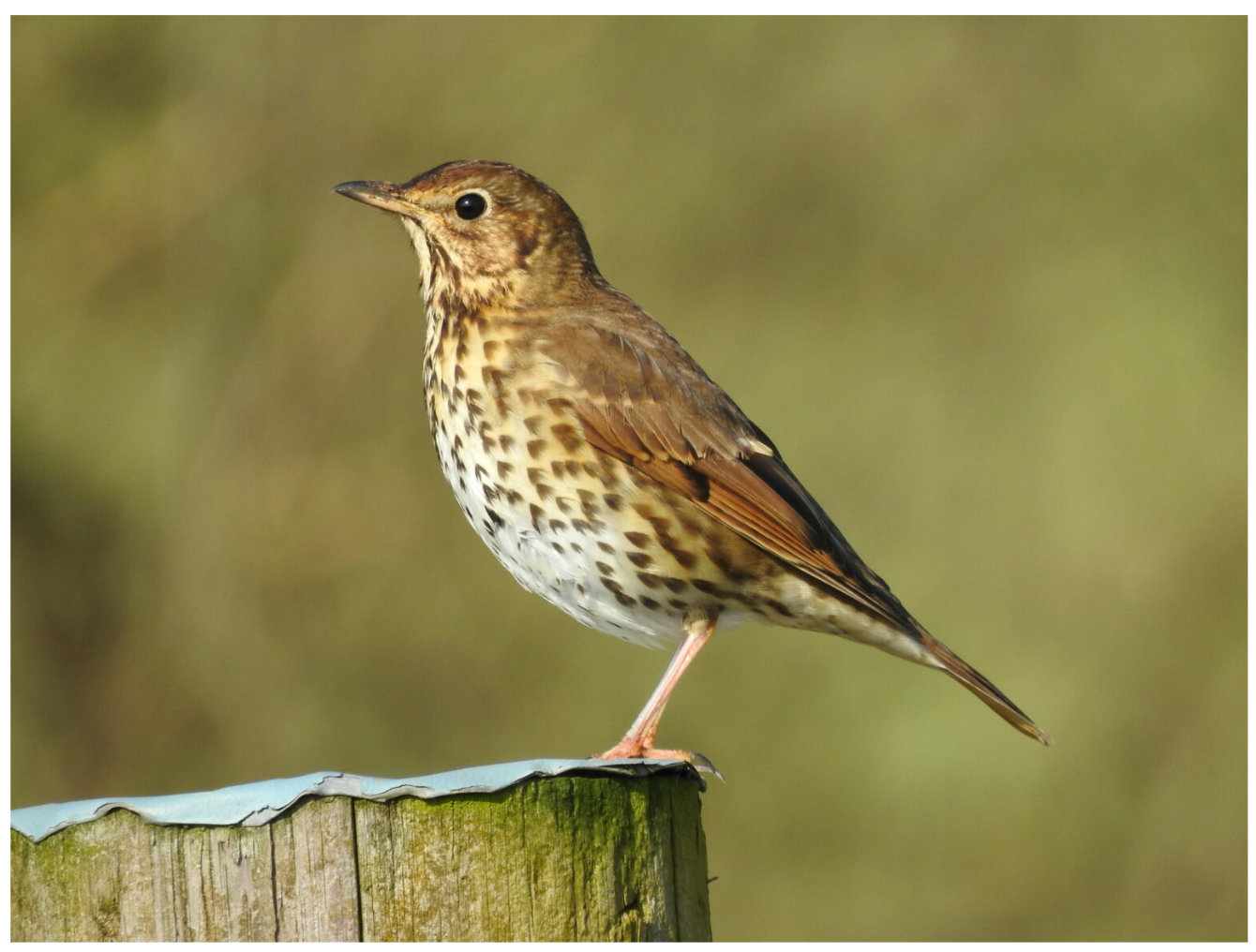
    Song Thrush

    song thrush

    The smaller, warmer and more compact of our two familiar
    spotted resident thrushes.

    The Song Thrush
    (Turdus philomelos) has warm brown upperparts,
    creamy underparts and relatively neat dark spots. It has
    a wingspan of roughly 33–36cm.

    Its compact shape is useful when separating it from the
    larger Mistle Thrush. The breast markings often appear
    rather like small arrowheads or upside-down hearts.

    Its voice is another excellent clue. A Song Thrush often
    repeats a short musical phrase several times before moving
    on to a different phrase.

    Resident

    Mistle Thrush

    Bigger, paler and more upright than the Song Thrush.

    The Mistle Thrush
    (Turdus viscivorus) is the largest of the familiar
    British thrushes, with a wingspan of around 42–48cm.

    It generally appears colder and greyer than a Song Thrush,
    with a pale breast carrying larger, bolder dark spots.
    Its stance is noticeably upright and it often looks longer
    and more powerful.

    In flight, pale outer tail edges can also help identify it.
    Mistle Thrushes have a strong rattling call and are often
    conspicuous when defending berry-bearing trees.

    Winter visitor

    Redwing

    redwing

    The Redwing
    (Turdus iliacus) is the smallest thrush that regularly
    visits Britain and is mainly seen here during autumn and winter.

    At first it can resemble a Song Thrush, but two field marks
    are particularly helpful: a strong pale stripe above the eye
    and rusty red-orange colouring beneath the wings and along
    the flanks.

    Winter visitor

    Fieldfare

    fieldfare

    Fieldfares
    (Turdus pilaris) arrive in Britain in large numbers
    for the winter and are often seen feeding communally in fields
    or descending on berry-laden trees.

    They are striking birds once you learn the pattern: grey head
    and rump, chestnut-brown back, dark tail and a buff-toned,
    spotted breast.

    Unlike the more solitary Song Thrush, Fieldfares are often seen
    in lively winter flocks, sometimes accompanied by Redwings.

    Upland visitor

    Ring Ouzel

    female ring ouzel

    The Ring Ouzel
    (Turdus torquatus) is closely related to the Blackbird
    and is particularly associated with upland landscapes.

    The male is very distinctive: predominantly black with a
    bold pale crescent across the breast. Females are browner
    and the breast band is less striking.

    In northern England it is a particularly appropriate bird
    to look for in upland country during the breeding season
    and during migration.

    The familiar thrush

    Blackbird

    blackbird

    It is easy to forget that the familiar
    Blackbird (Turdus merula) is itself
    a thrush.

    Adult males are unmistakably black with a bright yellow-orange
    bill and eye-ring. Females are brown and can appear lightly
    mottled or speckled, particularly on the breast.

    Blackbirds are the most widespread and familiar members of
    the family and are equally at home in woodland, farmland,
    gardens and around farm buildings.

    At Throstle Nest

    Listen as well as look

    Learning the thrushes is partly about plumage, but sound and
    behaviour can often identify a bird before you have had a
    really good look at it.

    The repeated song of the Song Thrush, the rattling call of
    the Mistle Thrush and the arrival of noisy winter Fieldfares
    all form part of the changing soundscape of the countryside.

    Once you begin to recognise them, the apparently similar
    brown birds feeding along a hedge or across a field become
    distinctly different characters.

  • Dales diary

    Dales diary

    Farming · Conservation · SFI 2026

    Farming for the Thrush

    How the Sustainable Farming Incentive can help restore the
    hedgerows, soils and field margins on which song thrushes and
    mistle thrushes depend.

    The Sustainable Farming Incentive (SFI) provides
    a number of practical ways for farmers to improve habitat for
    conservation-priority birds, including the
    song thrush and mistle thrush.

    Both species have experienced substantial historical declines
    across British farmland. Changes in hedgerow management,
    agricultural drainage and the availability of earthworms,
    snails and other invertebrates have all influenced the quality
    of the farmed landscape for thrushes.

    For farms such as Throstle Nest, this creates an interesting
    opportunity: measures intended to improve soils, field margins
    and hedgerows can also help restore the very habitats that gave
    the farm its name.

    Healthy hedges, living soils and rough field edges do more
    than improve the appearance of the countryside. Together,
    they create the feeding and nesting habitat on which
    farmland birds depend.

    Soil & cultivation

    More life beneath the surface

    Research into regenerative and conservation agriculture
    increasingly demonstrates how changes in cultivation can affect
    farmland bird communities.

    Farmers Weekly
    has reported on farmer-led trials examining the effect of
    cultivation systems on birds, including work associated with
    the Game & Wildlife Conservation Trust.

    Reduced cultivation, minimum tillage and direct-drilling can
    help preserve soil structure and biological activity. Where
    earthworm populations and other soil invertebrates increase,
    ground-feeding birds such as thrushes gain a more reliable
    source of food.

    This is particularly important during the breeding season,
    when adult birds must repeatedly find soft-bodied prey for
    their young.

    What thrushes need

    Cover to nest.
    Ground on which to feed.

    Thrushes benefit from dense nesting habitat together with
    damp, biologically active ground containing earthworms,
    beetles, snails and other invertebrates.

    SFI 2026

    Farming actions that can help

    Under the evolving SFI 2026 framework, several
    complementary management actions can contribute to better
    thrush habitat across the farm.

    01

    Hedgerow management

    Song thrushes can begin nesting very early in the year
    and dense hedges provide valuable nesting cover.
    Hedgerows also provide berries and other food through
    autumn and winter.

    Rotational cutting and allowing sections of hedge to
    develop more fully can create a thicker, more varied
    structure while maintaining a continuing supply of
    fruit and cover.

    02

    Grassy field corners and blocks

    Areas of longer, tussocky grass can protect damp soil
    and create habitat for beetles, snails, worms and
    other invertebrates.

    These less intensively managed areas provide useful
    feeding ground alongside the more productive parts
    of the farm.

    03

    Multi-species cover and low-input grassland

    Diverse plant cover and lower-input grassland
    management can improve soil structure, organic matter
    and biological activity.

    A richer soil ecosystem ultimately supports the
    invertebrates upon which thrushes and many other
    farmland birds depend.

    04

    Buffer strips and wider field margins

    Uncultivated margins provide a transition between
    productive farmland, hedges, woodland and watercourses.

    For thrushes, these areas can provide relatively
    undisturbed ground for feeding while also increasing
    the diversity of plants and insects across the farm.

    At Throstle Nest

    Farming with the landscape

    The attraction of these measures is that bird conservation
    does not need to sit separately from the working farm.

    Better hedgerows, healthier soils, rougher margins and greater
    botanical diversity can all contribute to a more resilient
    agricultural landscape.

    If those changes also bring more song thrushes and mistle
    thrushes back into the fields and woods around Throstle Nest,
    they will be a particularly appropriate measure of success.