Wildlife · Birds · Nidderdale
Know Your Thrushes
Spotted breasts, winter visitors and familiar voices:
a simple guide to some of the thrushes that can be seen
around British farms, woods, gardens and fields.
Thrushes are among the most characteristic birds of the
British countryside. Some remain with us throughout the
year; others arrive with the changing seasons.
They are generally ground-feeding birds, searching for
earthworms, insects, snails and other invertebrates, while
many also depend heavily on berries and fruit.
At first glance several species can look remarkably alike.
Size, posture, colour, breast markings and behaviour provide
useful clues to telling them apart.
The quick test
Size. Colour. Spots. Behaviour.
When you see a spotted thrush, first ask whether it looks
warm brown or cold grey-brown, whether it is compact or
upright, and whether the breast spots are small and
arrow-shaped or large and rounded.
Resident
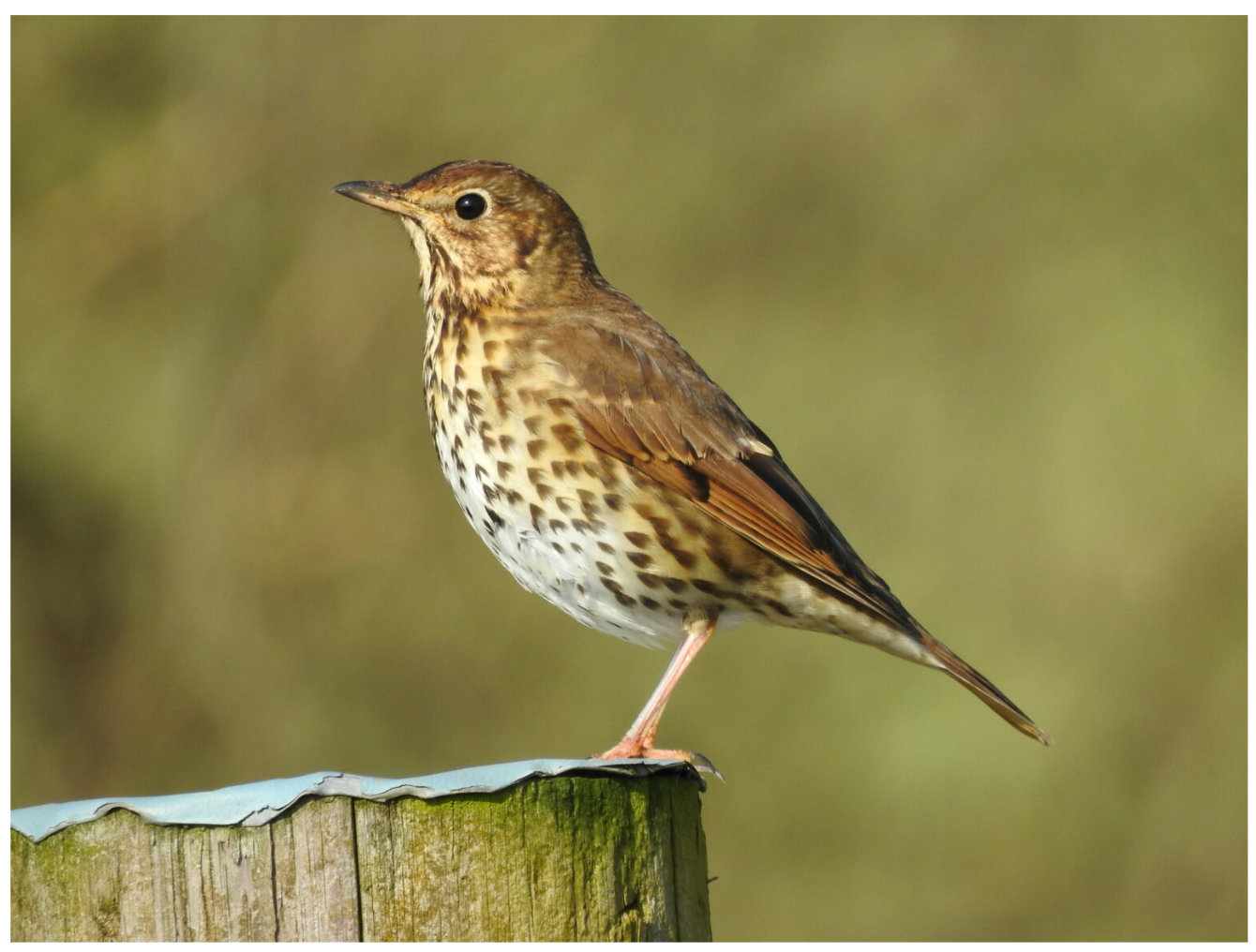
Song Thrush

The smaller, warmer and more compact of our two familiar
spotted resident thrushes.
The Song Thrush
(Turdus philomelos) has warm brown upperparts,
creamy underparts and relatively neat dark spots. It has
a wingspan of roughly 33–36cm.
Its compact shape is useful when separating it from the
larger Mistle Thrush. The breast markings often appear
rather like small arrowheads or upside-down hearts.
Its voice is another excellent clue. A Song Thrush often
repeats a short musical phrase several times before moving
on to a different phrase.
Resident
Mistle Thrush

Bigger, paler and more upright than the Song Thrush.
The Mistle Thrush
(Turdus viscivorus) is the largest of the familiar
British thrushes, with a wingspan of around 42–48cm.
It generally appears colder and greyer than a Song Thrush,
with a pale breast carrying larger, bolder dark spots.
Its stance is noticeably upright and it often looks longer
and more powerful.
In flight, pale outer tail edges can also help identify it.
Mistle Thrushes have a strong rattling call and are often
conspicuous when defending berry-bearing trees.
Winter visitor
Redwing

The Redwing
(Turdus iliacus) is the smallest thrush that regularly
visits Britain and is mainly seen here during autumn and winter.
At first it can resemble a Song Thrush, but two field marks
are particularly helpful: a strong pale stripe above the eye
and rusty red-orange colouring beneath the wings and along
the flanks.
Winter visitor
Fieldfare

Fieldfares
(Turdus pilaris) arrive in Britain in large numbers
for the winter and are often seen feeding communally in fields
or descending on berry-laden trees.
They are striking birds once you learn the pattern: grey head
and rump, chestnut-brown back, dark tail and a buff-toned,
spotted breast.
Unlike the more solitary Song Thrush, Fieldfares are often seen
in lively winter flocks, sometimes accompanied by Redwings.
Upland visitor
Ring Ouzel

The Ring Ouzel
(Turdus torquatus) is closely related to the Blackbird
and is particularly associated with upland landscapes.
The male is very distinctive: predominantly black with a
bold pale crescent across the breast. Females are browner
and the breast band is less striking.
In northern England it is a particularly appropriate bird
to look for in upland country during the breeding season
and during migration.
The familiar thrush
Blackbird

It is easy to forget that the familiar
Blackbird (Turdus merula) is itself
a thrush.
Adult males are unmistakably black with a bright yellow-orange
bill and eye-ring. Females are brown and can appear lightly
mottled or speckled, particularly on the breast.
Blackbirds are the most widespread and familiar members of
the family and are equally at home in woodland, farmland,
gardens and around farm buildings.
At Throstle Nest
Listen as well as look
Learning the thrushes is partly about plumage, but sound and
behaviour can often identify a bird before you have had a
really good look at it.
The repeated song of the Song Thrush, the rattling call of
the Mistle Thrush and the arrival of noisy winter Fieldfares
all form part of the changing soundscape of the countryside.
Once you begin to recognise them, the apparently similar
brown birds feeding along a hedge or across a field become
distinctly different characters.